
Arrest Warrants in Poweshiek County
Here is how an arrest warrant gets moving in Poweshiek County. An officer who thinks the evidence backs charges files a complaint with the Clerk. A magistrate then reads it. From there, the magistrate can issue a summons or sign an arrest warrant. The Poweshiek County criminal-process page walks through that sequence. The rules come from Iowa Code chapter 804, which spells out probable cause, what a warrant must contain, bail endorsement, execution and return, what gets communicated after an arrest, initial appearance, and a confidentiality window for the papers that secured the warrant. An arrest warrant authorizes custody and nothing more. It sets no bond on its own and settles nothing. A public docket can show an event before every related paper is public. Juvenile, sealed, and mental-health matters may stay off the docket entirely. For a warrant search, note that Poweshiek County publishes no official Sheriff warrant roster. Start with Iowa Courts Online, the public case index, then confirm status directly with the court. Basic case searching needs no registration. A new case can take one business day to show up, and updates are described as real-time once indexing finishes. Courthouse terminals reach trial documents the basic online view hides, while bonds, service returns, schedules, and exhibits may need terminal or subscription access. Those gaps are why the Clerk matters so much in any current arrest-warrant check.
Poweshiek County Arrest Warrant Complaint Review
Poweshiek County follows Iowa criminal procedure from the first complaint onward. Iowa Code section 804.1 covers the probable-cause complaint or affidavit, section 804.2 spells out what the warrant must contain, and section 804.3 handles the bail endorsement. Once a magistrate approves the complaint, an arrest warrant may follow. A minor case can skip that step entirely. The magistrate may issue a summons directing an appearance in Magistrate Court instead.
- An officer develops information and files a complaint with the Clerk.
- A magistrate reviews whether the complaint supports probable cause.
- The magistrate selects a summons or arrest warrant under the case facts.
- An authorized agency serves the warrant and later files a return.
- The person receives an initial appearance and the case continues.
An investigation can also end in arrest at the scene, with no paper review first. In Poweshiek County, read the actual docket rather than assuming this sequence.
What a Poweshiek County Arrest Warrant Contains
A public Poweshiek County case can show identifiers, charges, dates, the judicial authority, bond information, and later status events. Access level matters. The warrant itself and its supporting affidavit may hold detail a short docket line never shows. And a public case title or charge can appear even while the warrant-securing filing stays confidential.
| Case identifier | Case ID, case type, county, citation or reference number, and sequence. |
|---|---|
| Authority | District, District Associate, or Magistrate Court and judge or magistrate. |
| Allegation | Charge, count, description, and felony or misdemeanor class. |
| Warrant event | Issue date and status wording when publicly docketed. |
| Bond block | Set amount, type, date, posted amount, or no-bond notation when entered. |
| Return/status | Served, returned, recalled, or another later event and date. |
A party name can surface in the case interface in Poweshiek County. Similar names are not proof of identity, so private details should not be copied or republished.
Poweshiek County Arrest Warrant Affidavits Can Stay Sealed
Iowa Code section 804.29 seals a citation and the affidavits filed to secure an arrest warrant. The seal lasts until the arrest is made and the warrant is returned, or until an initial appearance is held. During that window, only authorized roles see the material. A thin public entry in Poweshiek County can reflect that law. It may not be a faulty search at all.
Record-reading rule:
A docketed warrant event is not the complete arrest warrant.
A restricted affidavit is not evidence that no case or warrant exists.
A charge is an allegation and should not be described as a conviction.
Iowa Code chapter 22 opens public records but carves out confidential categories. For a Poweshiek County record, ask the proper custodian for the specific document and any segregable public portion.
How Poweshiek County Arrest Warrants Are Served
The court issues an arrest warrant, but the Poweshiek County Sheriff executes it and files the return. The office sits at 4802 Barnes City Road, Montezuma, with mail to PO Box 297. Its general line is 641-623-5679. Posted hours run weekdays from 8 a.m. to 4 p.m. The Sheriff posts no separate warrant-unit extension, no public surrender calendar, and no guaranteed walk-in process, so call first. That call matters before any trip. It matters doubly for anyone who spots a possible match. Never approach another person based on one. Behind the scenes, Iowa's restricted IOWA System links more than 450 authorized police, sheriff, state, and federal agencies with NCIC and other networks. It is an enforcement tool, not a public search. Agencies can therefore hold broader, fresher data than a citizen's docket view. Records requests have their own limits. A Chapter 22 request can seek a specific existing Sheriff record open to inspection, but it cannot force a public warrant list. Ask for the custodian, a fee estimate, and any releasable redacted portion. Confidentiality rules may still bar disclosure before execution. Mail goes to PO Box 297, and the published fax is 641-623-5120. Poweshiek County lists no warrant-specific email, form, fee, response time, or identification rule, so confirm the route before sending anything sensitive.
Poweshiek County Arrest Warrant Office Roles
Three Poweshiek County offices touch different parts of an arrest-warrant matter. The Clerk keeps the court case and explains record procedure. The Sheriff answers agency-held enforcement and service questions. The County Attorney explains charging and prosecution, though it is no public warrant database and no personal legal-advice office.
Clerk of Court, Poweshiek County
Current docket event, hearing, bond entry, filed return, and public record access.
641-212-4232
Poweshiek County Sheriff
Agency-held enforcement information and instructions that can lawfully be released.
641-623-5679
Poweshiek County Attorney
Prosecution and published criminal-process information, not defense advice.
641-623-5135
The current Judicial Branch Clerk number conflicts with the older 641-623-5644 in County Attorney material. Start with 641-212-4232 for Poweshiek County.
Arrest Warrant vs Summons vs Bench Warrant
A warrant, a summons, and a bench warrant bring different obligations. They share the same Iowa court system. In Poweshiek County, the instrument, its origin, the latest event, and the court's own instructions matter more than any informal label.
| Record | How it begins | Main effect | Key next check |
|---|---|---|---|
| Arrest warrant | Probable-cause complaint approved by a magistrate | Authorizes arrest | Current status, bond, service, and initial appearance |
| Summons | Magistrate chooses an appearance order in place of immediate arrest authority | Commands appearance | Date, place, and case instructions |
| Bench or FTA warrant | Often follows a missed court obligation | Authorizes arrest under the court case | Recall or quash procedure, hearing, bond, and status |
Iowa paperwork often labels a failure-to-appear warrant as an arrest warrant. In Poweshiek County, follow the wording on your own docket. A warrant served, a summons appearance finished, or a bench warrant recalled still leaves the underlying allegation for the court.
Poweshiek County Arrest Warrant Initial Appearance
Expect an initial appearance quickly after an arrest in Poweshiek County. The County Attorney describes what happens there. A magistrate goes over the complaint, the possible penalties, and how to apply for appointed counsel. Bail in Poweshiek County can mean cash, pretrial supervision, evaluations, no-contact terms, or other conditions tied to the case.
- Initial appearance
- An early proceeding addressing the complaint, counsel, conditions, hearing rights, and bail.
- Preliminary hearing
- A probable-cause proceeding that the county says is uncommon when trial information serves a similar role.
- Trial information
- A formal charging document with minutes of testimony reviewed by a district judge.
- Return
- The agency filing that reports execution or disposition of the warrant.
Obtain the next hearing date and comply with every release and no-contact condition.
What to Do If There's a Warrant for You
Work from the actual case, not what a caller tells you. A Poweshiek County warrant check starts with Iowa Courts Online, searchable by name, case ID, or citation. Ask the Clerk about the latest warrant event, bond, hearing date, and public filings. The Sheriff handles service and surrender questions, and an Iowa attorney can advise on every step from voluntary surrender to defenses.
Use verified instructions.
Do not assume a walk-in procedure, send money to a caller, or treat fine payment as automatic warrant recall.
When a bond is posted, confirm the amount, the type, and where payment is actually allowed. Keep the receipt. Get the next hearing date and any release conditions in writing. The Poweshiek County resolution overview walks through the two-office route in more detail. Serving or recalling the warrant only clears that piece. The criminal allegation itself stays pending for later court proceedings. Before each call, gather the case identifier, any official notice, and prior receipts. Ask who issued the warrant, which agency holds it, what bond or conditions are on record, and what written proof confirms the next step. If another Iowa county or a federal court issued it, Poweshiek County offices can point you to the right venue, but they cannot substitute for that court's instructions.
Poweshiek County Arrest Warrant Safety Sources
The Grinnell Police page offers a local contact and records route for Poweshiek County. Criminal cases here still run through the state's unified District Court system, so the city office and the county court each hold different pieces of a warrant file.
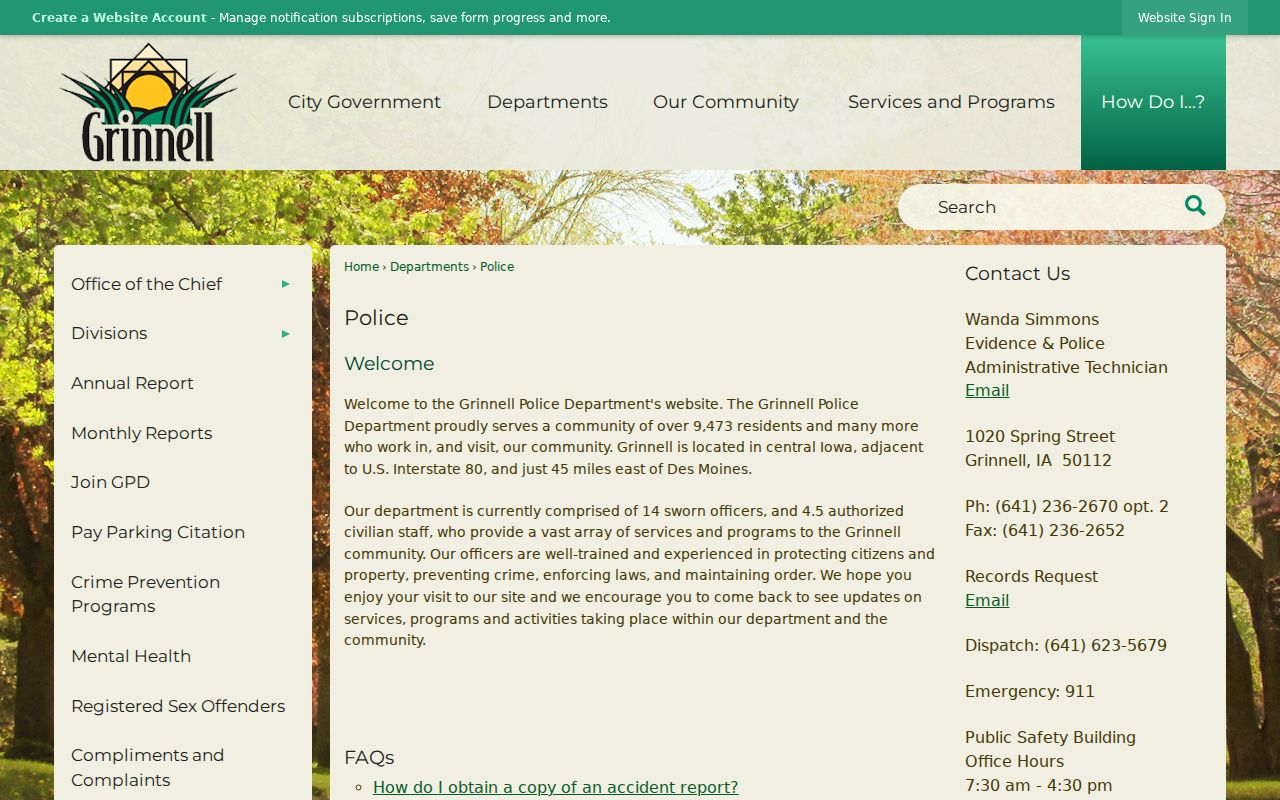
Call the right office first. Confirm which agency and which court hold the record before you request anything. Also worth reading: the June 2026 Judicial Branch warning on fake warrant and payment demands, which Poweshiek County residents have reason to heed.
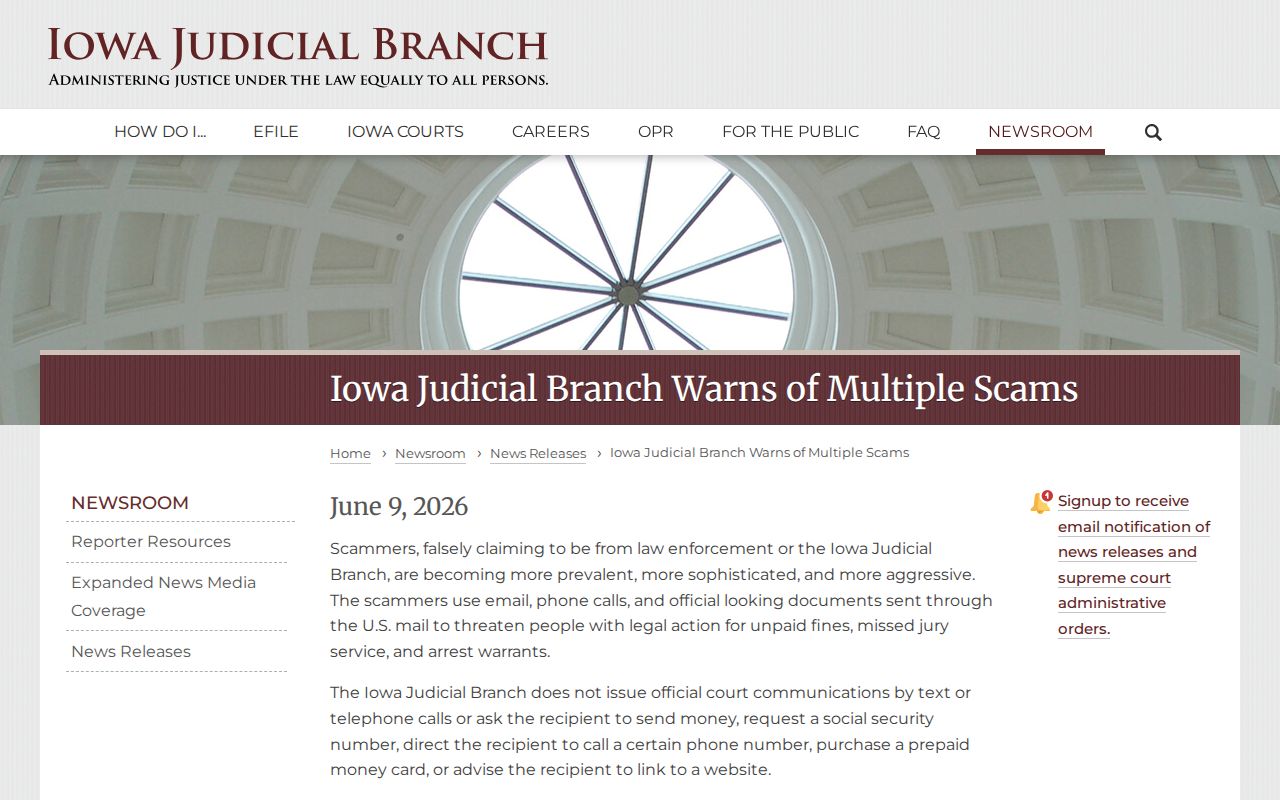
Iowa courts never demand money, Social Security numbers, prepaid cards, or payments through odd links by phone or text. Police do not collect court fines either. So call a published Poweshiek County number, never one that arrives in an unsolicited message. If a threat feels immediate, report it through the proper official channel.